How to Read an Olive Oil Lab Analysis: A Parameter-by-Parameter Guide (2026)
A practical walkthrough of every figure on an olive oil Certificate of Analysis, from free acidity to individual phenolics, so you can judge quality beyond the label.
A Certificate of Analysis, usually shortened to COA, is the closest thing olive oil has to an honest second opinion. It sets aside the label, the medal stickers and the harvest romance and reports what a laboratory actually measured in the oil. For a buyer trying to judge quality, a COA is the most reliable document available, but only if you can read it. A page of acronyms and decimal thresholds is easy to nod along to and hard to interpret.
This guide walks through every parameter you are likely to find on an olive oil lab report, grouped sensibly, and explains for each one what it measures, why it matters and what threshold separates compliant oil from the rest. We regard the legal limits set by the International Olive Council (IOC) and EU regulation as authoritative. Where we describe tiers such as "good" or "exceptional," those are editorial guidance based on what we see across the market, not legal definitions. For how we apply all of this when listing oils, see our methodology; to compare the figures themselves, see the oils we track and list.
Two kinds of numbers on a COA
Before the line-by-line detail, it helps to separate a COA into two families of figures, because they answer different questions.
The first family is the chemical-purity and quality parameters: free acidity, peroxide value, the UV absorbance indices and a handful of freshness markers. These determine whether an oil legally qualifies as extra virgin and whether it has been damaged by poor fruit, careless processing, heat, light or age. They are largely about defects and integrity.
The second family is the phenolic content: total polyphenols and, on better reports, a breakdown of individual compounds. These figures are what the high-polyphenol category is built on, and they are the headline most buyers care about. Crucially, the two families are independent. An oil can be flawless on every purity parameter and still be modest in polyphenols, and a polyphenol-rich oil still has to pass the purity tests to be called extra virgin at all.
Chemical quality parameters
Free acidity (free fatty acids)
Free acidity measures the proportion of free fatty acids in the oil, expressed as a percentage of oleic acid by weight. As olive fruit deteriorates, or as the oil is mishandled, the bonds holding fatty acids in the oil's triglycerides break and release free fatty acids. So free acidity is essentially a record of how healthy the fruit was and how cleanly it was processed.
It is worth being clear about what free acidity is not. It is not something you can taste; the free fatty acids it counts are odourless and flavourless at these levels. It is not a measure of polyphenols, and a low acidity figure tells you nothing about phenolic content. It is simply a signal of fruit quality and processing care.
The IOC trade standard and EU rules set the extra virgin limit at no more than 0.8%. In practice, well-made oils sit far below that ceiling, and many premium early-harvest oils report figures under 0.2%. We discuss this parameter in more depth in our dedicated explainer on olive oil acidity.
| Free acidity (% as oleic acid) | Reading |
|---|---|
| ≤ 0.8% | Legal extra virgin limit (IOC / EU) |
| < 0.3% to 0.5% | Editorial guidance: very good |
| < 0.2% | Editorial guidance: exceptional |
Peroxide value
Peroxide value measures primary oxidation products, expressed in milliequivalents of active oxygen per kilogram of oil (meq O2/kg). When oil begins to oxidise, the first compounds it forms are hydroperoxides, and the peroxide value counts them. It is one of the clearest indicators of freshness and of how well the oil has been protected from oxygen, light and heat.
A low peroxide value means oxidation has barely begun. A high one means the oil is well into the process that ends in rancidity. Because peroxides are an early-stage product, however, a very old or heavily oxidised oil can sometimes show a moderate peroxide value as those primary products break down into later compounds, which is one reason the UV indices below are needed alongside it.
The extra virgin limit is no more than 20 meq O2/kg. Fresh, carefully stored oils typically sit well below this, often in the single digits to low teens.
| Peroxide value (meq O2/kg) | Reading |
|---|---|
| ≤ 20 | Legal extra virgin limit (IOC / EU) |
| < 10 | Editorial guidance: fresh, well protected |
K232, K270 and Delta-K (UV absorbance)
These three indices come from shining ultraviolet light through the oil and measuring how much it absorbs at specific wavelengths. Certain oxidation and refining by-products absorb UV light strongly, so the readings expose problems that acidity and peroxide value can miss. The methods are defined in EU Regulation (EEC) No 2568/91, the foundational text for olive oil analysis methods, and mirrored in the IOC trade standard.
K232 reads absorbance at 232 nanometres and reflects primary oxidation, the conjugated dienes formed early in the process. It tends to move alongside peroxide value but catches oxidation history that peroxides alone may have moved past.
K270 reads absorbance at 270 nanometres and reflects secondary oxidation, the carbonyl compounds that form as oxidation advances. An elevated K270 is also a classic sign that refined oil has been blended in, because refining generates compounds that absorb at this wavelength.
Delta-K (ΔK) is a small calculation derived from absorbance at 270 nanometres and the two adjacent wavelengths. It is primarily an adulteration and refining marker: genuine virgin oil shows a characteristic curve, and refined or improperly processed oil distorts it. A ΔK above the limit is a strong indication that the oil is not what it claims to be.
| UV index | Extra virgin limit (IOC / EU) | What it flags |
|---|---|---|
| K232 | ≤ 2.50 | Primary oxidation |
| K270 | ≤ 0.22 | Secondary oxidation; refined-oil blending |
| Delta-K (ΔK) | ≤ 0.01 | Adulteration / refining |
Oleic acid content
Oleic acid is the dominant monounsaturated fatty acid in olive oil, reported as a percentage of total fatty acids. Olive oil's reputation for stability rests largely on its high oleic acid content, because monounsaturated fats resist oxidation far better than the polyunsaturated fats that dominate most seed oils.
The figure varies by cultivar, climate and ripeness, and the genuine range is wide, roughly 55% to 83%. A higher oleic figure is generally associated with greater oxidative stability and longer shelf life, but it is a varietal characteristic rather than a quality grade in itself, so it should be read as context rather than a pass-or-fail threshold.
Polyphenols: the headline, and its caveats
Total polyphenols (biophenols)
Total polyphenols, sometimes labelled total biophenols, is the figure most buyers in this category look for first, usually expressed in milligrams per kilogram (mg/kg). It is the closest single number to the health-relevant content of the oil, and it is also the one most easily misread.
The first complication is that "total polyphenols" is not one defined measurement. Different laboratory methods produce different numbers for the same oil. The Folin-Ciocalteu colorimetric method reports a single total and tends to read highest, because it reacts with some non-phenolic compounds as well. HPLC methods separate and quantify individual phenolics. The HPLC procedure behind the regulated EU figure specifically measures hydroxytyrosol and its derivatives. Because these approaches define and count "polyphenol" differently, their results are not interchangeable, and a number with no stated method is not verifiable. We cover this in detail in our guide to lab testing methods for polyphenols.
The second complication is what we call the polyphenol paradox. A large total figure can be inflated by precursor compounds rather than the most-studied bioactive ones. Oleuropein aglycone, for example, is a precursor that can contribute heavily to a total while the bioactive oleocanthal and oleacein remain modest. Two oils can both report, say, 600 mg/kg total, yet have very different breakdowns. This is why the total is a starting point, not a verdict: the breakdown of individual compounds tells you far more. For the bigger picture, see our explainer on what polyphenols are in olive oil.
| Method | What it reports | Tendency |
|---|---|---|
| Folin-Ciocalteu | Single total in gallic acid equivalents | Reads highest; includes some non-phenolics |
| HPLC | Individual compounds, summed or listed | More specific; method and standard matter |
| EU-claim HPLC procedure | Hydroxytyrosol and derivatives | The figure behind the authorised health claim |
Individual phenolics
Where a report breaks the total into named compounds, it becomes far more useful. These are the ones worth knowing.
Hydroxytyrosol is the compound at the centre of the EU health claim, a simple phenol that has been studied extensively for its antioxidant activity. Tyrosol and several oleuropein-derived compounds are counted alongside it as "hydroxytyrosol and derivatives" for regulatory purposes. Our dedicated page on hydroxytyrosol covers it in full.
Tyrosol is a closely related phenol, structurally similar to hydroxytyrosol and grouped with it in the regulated figure.
Oleocanthal is responsible for the peppery sting at the back of the throat that high-polyphenol oils produce. In a 2005 paper in Nature, Beauchamp and colleagues reported that oleocanthal acts on the same enzymes in laboratory studies as the anti-inflammatory drug ibuprofen, which is why the compound is so often discussed. That finding describes laboratory pharmacology, not a dietary outcome.
Oleacein is oleocanthal's close relative, associated in laboratory work with antioxidant activity and typically tracking alongside oleocanthal in fresh, robust oils. We cover both compounds together in our guide to oleocanthal and oleacein.
Oleuropein is primarily a precursor compound, abundant in the olive fruit and leaf, that converts into other phenolics as the oil is made and ages. Its presence in oil is normal, but because it is a precursor it can swell a total figure without reflecting the more-studied bioactive fraction, which is the polyphenol paradox in concrete form.
The one authorised EU health claim
One health claim may legally be made for olive oil polyphenols in the EU, and it is worth stating precisely. Under Commission Regulation (EU) No 432/2012, the authorised claim is that "olive oil polyphenols contribute to the protection of blood lipids from oxidative stress." It may be used only for oil that provides at least 5 mg of hydroxytyrosol and its derivatives per 20 g of oil, which corresponds to roughly 250 mg/kg, and the labelling must also state that the beneficial effect is obtained with a daily intake of 20 g of olive oil. Any phrasing that goes beyond this is not authorised, however common it is in marketing.
The condition matters more than it first appears, because most oils never meet it. Around 90% of Italian retail extra virgin oils (Caporaso et al., 2015) and 96% across a seven-country sample (Pedan et al., 2019) fall below that 250 mg/kg floor. So a polyphenol line on a COA is exactly the kind of lab-verified figure that tells you more than the "extra virgin" label ever could. How much of that oil you would need for the claim depends on its concentration: a 2,000 mg/kg oil delivers the 5 mg in a much smaller serving than one scraping past the floor, which we walk through in our guide to how much polyphenol olive oil to take daily. For how strong the evidence is across the outcomes people ask about, see our health evidence overview.
Freshness and age markers
Two further parameters appear on more thorough reports and are useful for judging how fresh an oil really is, independent of any printed best-before date.
Diacylglycerols (DAGs), usually reported as the percentage of the 1,2 isomer, indicate freshness. In freshly pressed oil the 1,2 form dominates, and over time and with poor handling it rearranges into the 1,3 form. A high proportion of 1,2-DAG points to a fresh, well-made oil, while a falling ratio suggests age or fruit that was already deteriorating at harvest.
Pyropheophytins (PPP), reported as a percentage, are breakdown products of chlorophyll that accumulate slowly as oil ages and especially when it is exposed to heat. A low PPP figure indicates a young oil that has not been heated; a rising figure indicates age or thermal abuse. Together, DAGs and PPP give a chemical read on freshness that complements the harvest date and can expose oils that are older than their packaging implies.
| Marker | Indicates | Direction |
|---|---|---|
| 1,2-DAG (%) | Freshness | Higher is fresher |
| Pyropheophytins, PPP (%) | Age / heat exposure | Lower is fresher |
Reading a COA as a whole
No single line on a COA settles the question of quality. The purity parameters tell you whether the oil is genuinely extra virgin and free of the defects, oxidation and adulteration that the law screens for. The freshness markers tell you whether it is as young as it claims. The polyphenol figures, read as a breakdown rather than a lone total, tell you about the phenolic content that defines this category. An oil worth buying should clear the legal thresholds comfortably and, ideally, publish a named-method polyphenol breakdown rather than a single unattributed number.
If you want to put these parameters to work, our guide to choosing a high-polyphenol olive oil turns the chemistry into a buying checklist, and our note on spotting fake olive oil explains which of these figures are hardest to fake. A COA does not make the decision for you, but read carefully it gives you the only view of an oil that the label cannot edit.
Put this check into practice
Start with the report behind a current example such as Green Machine or Citizens of Soil Health Club, then compare their reported fields in the high-polyphenol olive oil dataset. Use the full buyer framework when you are weighing trade-offs beyond the COA. If delivery determines the shortlist, the live UK ranking and Germany ranking apply the same evidence checks to their available oils.
A COA answers two different questions
Does it meet the grade?
- Free acidity, peroxide value and UV indices
- A batch-matched report, plus the required sensory assessment
- Whether the oil meets the criteria for its declared category
How phenol-rich is it?
- The method, unit and sampling date behind the number
- Total phenols versus individual phenolic compounds
- Whether the reported measurement supports the buyer's goal
Featured oils
Frequently asked questions
What is a Certificate of Analysis for olive oil?
A Certificate of Analysis (COA) is a laboratory report listing the measured chemical parameters of a specific oil or batch, such as free acidity, peroxide value, the UV absorbance indices and, often, polyphenol content. It documents whether the oil meets the legal criteria for its grade.
Does free acidity tell me how many polyphenols an oil has?
No. Free acidity measures free fatty acids and reflects fruit quality and processing care. It is not the same as polyphenol content, it is not something you can taste, and a low acidity figure does not imply a high polyphenol figure.
What are the legal limits for extra virgin olive oil?
Under the International Olive Council trade standard and EU rules, extra virgin olive oil must have free acidity no greater than 0.8%, peroxide value no greater than 20 meq O2/kg, K232 no greater than 2.50, K270 no greater than 0.22 and Delta-K no greater than 0.01, alongside a sensory panel assessment.
Why is the total polyphenol number sometimes misleading?
A large total can be driven by precursor compounds rather than the most-studied bioactive phenolics. This is sometimes called the polyphenol paradox: the headline figure looks high while the breakdown of compounds such as oleocanthal and oleacein is modest. Reading the breakdown is more informative than the total alone.
What is the only authorised EU health claim for olive oil polyphenols?
Under Commission Regulation (EU) No 432/2012 the authorised claim is that olive oil polyphenols contribute to the protection of blood lipids from oxidative stress. It may be used only for oil providing at least 5 mg of hydroxytyrosol and its derivatives per 20 g, and the label must state that the effect needs a daily intake of 20 g of olive oil.
Which polyphenol measurement method should appear on a credible report?
A credible report names the method, such as Folin-Ciocalteu for a total figure or an HPLC procedure for individual compounds, along with the unit (mg/kg) and the reference standard. Different methods produce different numbers, so a figure with no method stated is not verifiable.
How we reviewed this article
Written and edited by our editorial team and checked against primary research and EU regulation. We cite peer-reviewed studies and official sources, and prefer human trials and reviews over in-vitro work.
Sources
- Olive-oil conformity checks and analysis methods — EUR-Lex
- Permitted nutrition and health claims: olive oil polyphenols — EUR-Lex
- IOC standards, methods and guides — International Olive Council
Searching for olive oil for your health and longevity
Our top-ranked high-polyphenol olive oils, sorted by lab-verified content.
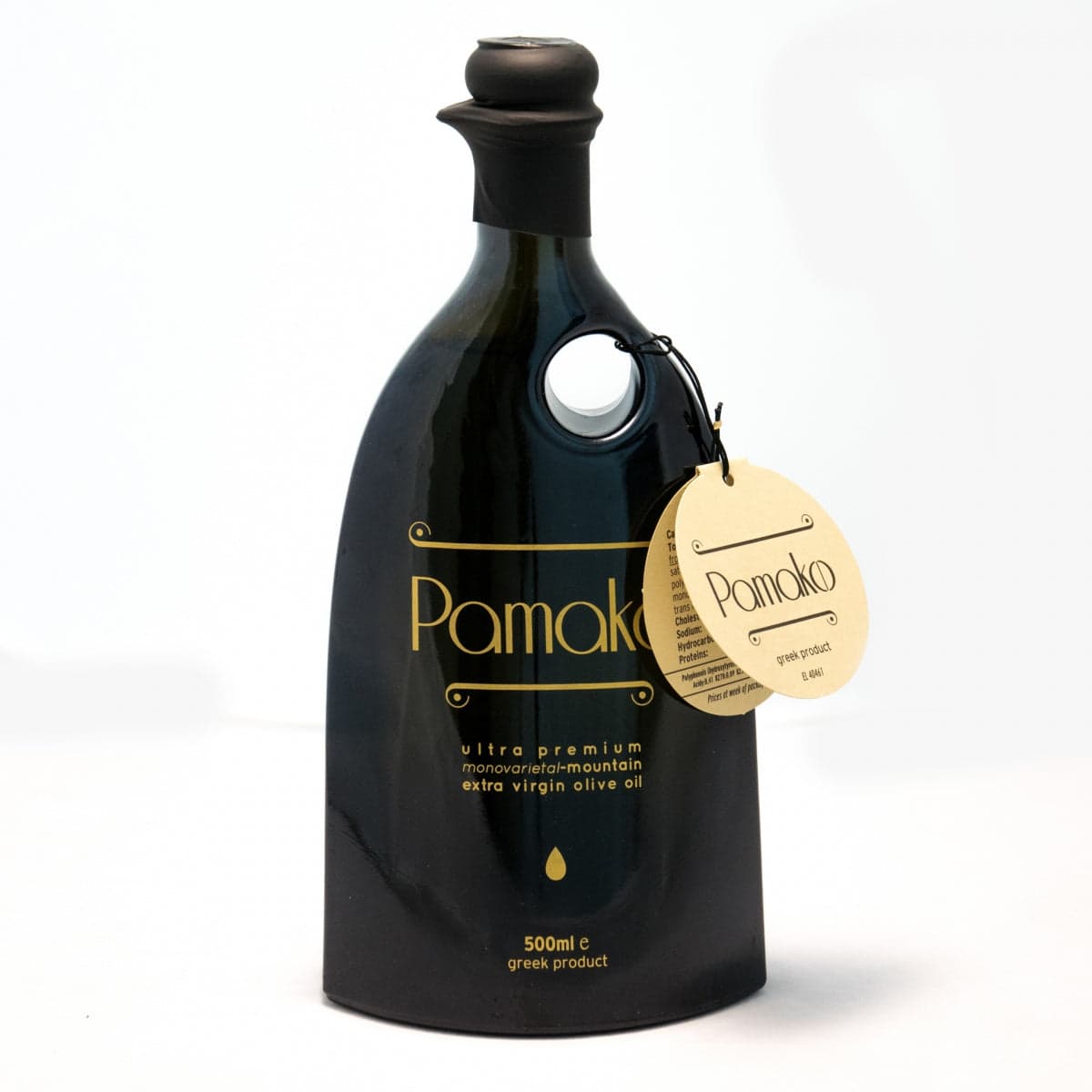
Pamako
€54.95· 500ml
€1.65 per 15ml serving
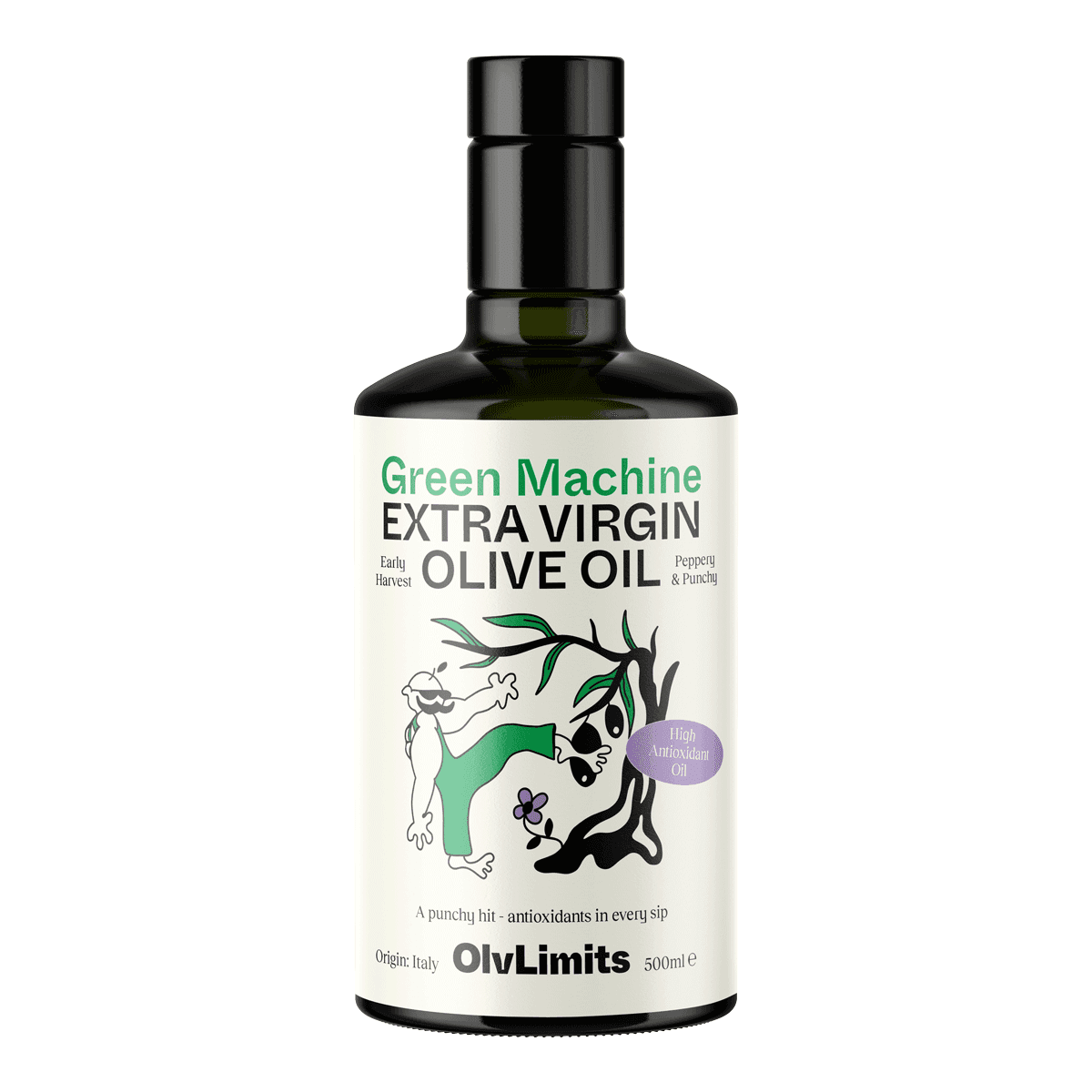
Green Machine
OlvLimits
€23.00· 500ml
€0.69 per 15ml serving
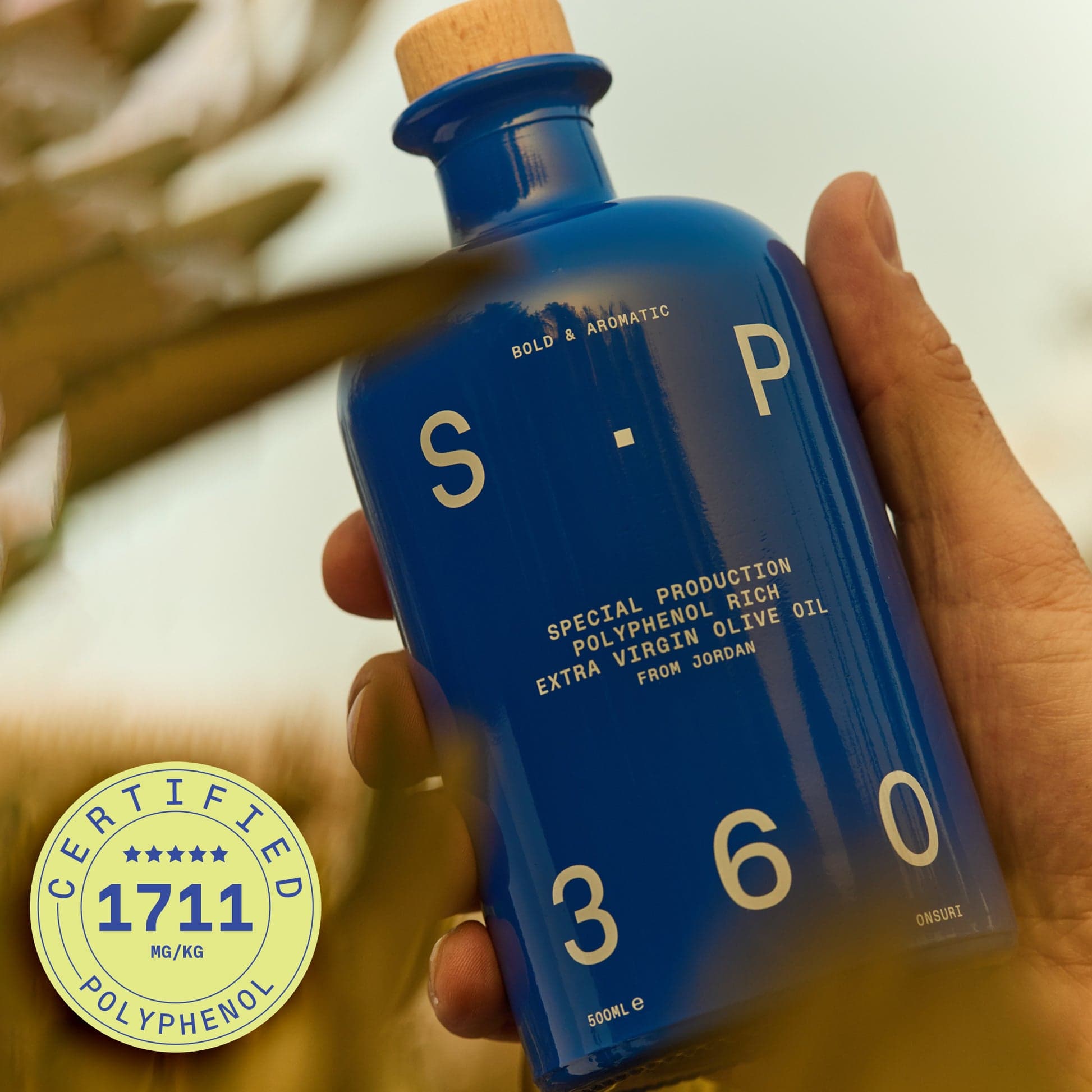
SP360
£42.00· 500ml
£1.26 per 15ml serving
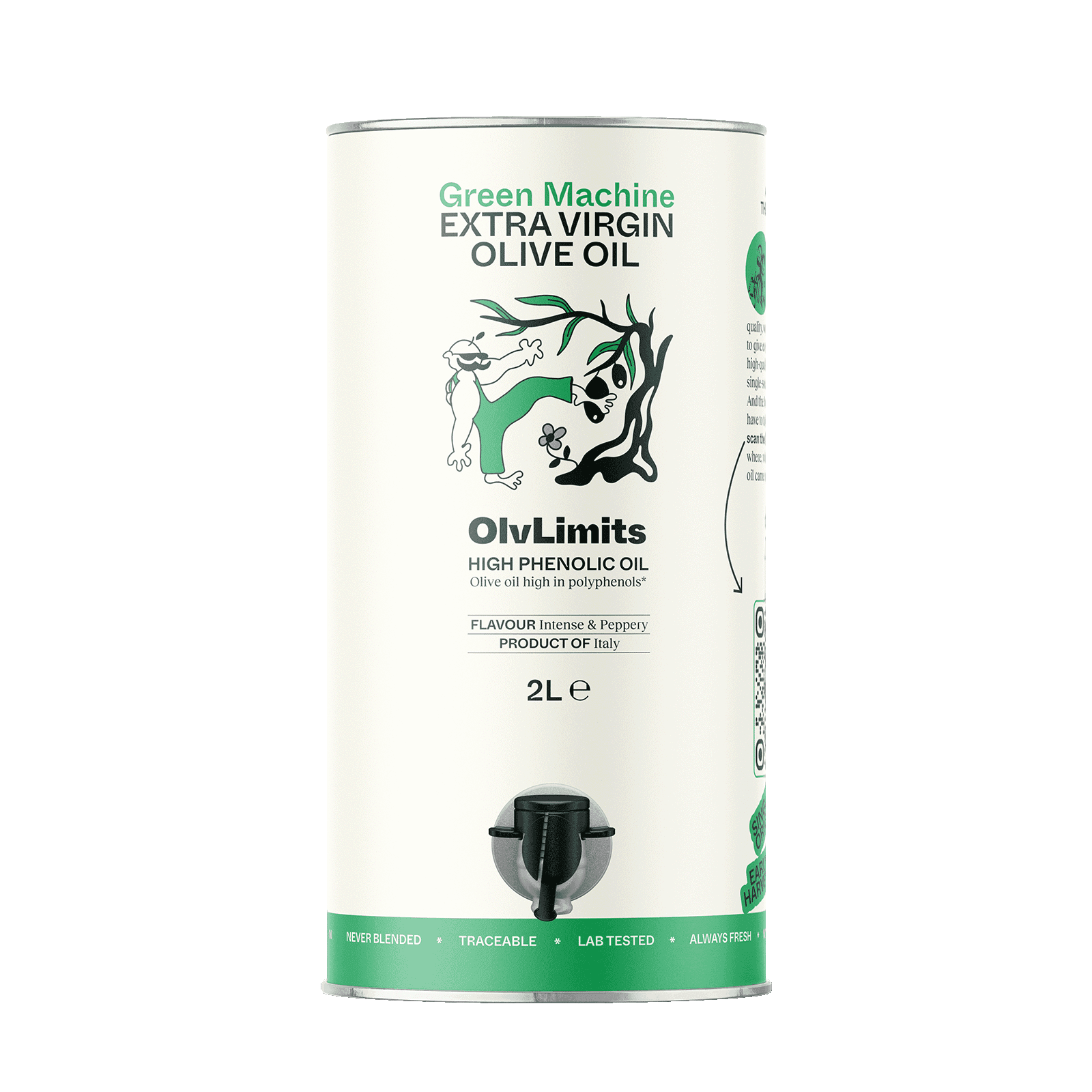
Green Machine 2L bag-in-tube
OlvLimits
€80.00· 2L(≈€20.00/500 ml)
€0.60 per 15ml serving